


In recent years, but especially in 2025, there have been several changes that impact the lives of those who live abroad and maintain assets and income in Brazil, or those who are tax residents in Brazil with assets and income abroad. Some are positive and others are far from it, but now there are several that deserve attention. Income tax in 2026 is expected to be very different from 2025, for more than one reason. There are also changes to the ITCMD (state tax on donations and inheritances), and 2027 will see the start of the collection of new taxes, IBS and CBS, especially for those who own real estate. There will be a lot to adapt to throughout 2026.
The purpose of this text is to highlight the three main changes that will deserve your attention throughout 2026. The topics are complex, so we have decided to develop more in-depth texts for each of them over the next three months. For now, here is our analysis at an introductory level.
Income Tax in 2026 (and other taxes): is it worth setting up a real estate holding company in 2026?
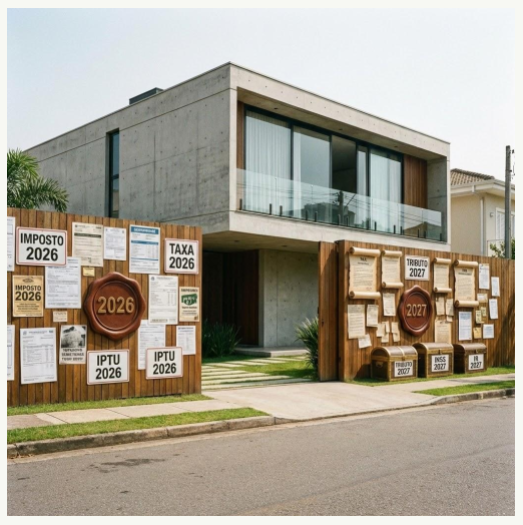
Of the topics we have discussed, it is certain that the investors most affected from 2027 onwards will be owners of real estate in Brazil for rental or sale. This sector is not normally taxed by ISS and ICMS (in general) or by PIS/COFINS (for individuals).
Starting in 2027, however, ISS and ICMS will begin to be replaced by IBS (tax on goods and services), in a gradual process expected to be completed in 2032. In 2027, there will also be CBS (contribution on goods and services) to replace PIS/COFINS entirely as early as 2027. These taxes will be levied on those who own investment properties, whether they are legal entities (always), individuals (in many situations), residents, or non-residents.
The taxation of the IBS/CBS is not yet fully clarified (the rates are still unknown), but it is already possible to gauge its effects. Some trends can be observed:
- Non-residents with rental income of at least R$ 288,000 per year (an average of R$ 24,000 per month) are likely to be affected by the IBS/CBS in 2027. In this case, it may make sense to set up a real estate holding company instead of holding the properties directly in your name, depending also on the rules of the country in which you live.
- For non-residents who own at least four rental properties with a total annual rental income of at least R$240,000 (an average of R$20,000 per month), the situation will remain unchanged. How are the four properties counted? Good question. We are still awaiting the regulations.
- For rental properties, it will make a difference to know whether we are dealing with a “normal” rental or a short-term rental (up to 90 days, as with Airbnb or Booking).
- For non-residents who intend to sell at least four properties in the same year, or intend to sell at least two properties that they have built in the last five years, the same situation may apply. How should the properties be counted? Good question.
- For those who are non-residents outside of the above situations, it may be possible to avoid IBS/CBS, so that maintaining operations as an individual may still make sense;
- For residents, the calculation of the benefits of keeping real estate in the name of an individual or a real estate holding company is likely to change significantly, but it is still unclear whether a real estate holding company will be more or less favorable than keeping it in the name of an individual.
At the same time, income tax will begin in 2026 with a 10% tax on dividends. This tax will affect resident individuals when they receive at least R$ 50,000 per month or R$ 600,000 per year, and non-residents in general whenever they receive dividends, regardless of the amount.
The combination of these two sets of rules promises to radically change the solutions currently used to secure real estate. We intend to address this issue in greater depth in February.
Donations and inheritances: income tax in 2026 and also the ITCMD

During 2025, there was discussion of bills on IBS/CBS tax reform (including on the topic of the previous section, on real estate), but within the same bills there were also planned changes to the ITCMD. And finally, Complementary Law No. 227/2026 was approved in January. The main highlights to be aware of are:
- The lack of complementary legislation to deal with donations and inheritances from abroad, as pointed out by the STF in Theme 825, has finally been addressed;
- Several loopholes used in succession planning have been closed, for example, by providing for the valuation of companies at market value instead of accepting their book value;
- Definition of how to treat foreign trusts for ITCMD purposes in the same way as they were treated for IRPF purposes in Law No. 14,754/2023, which enables the use of foreign trusts as an estate planning tool.
Not all changes can be implemented immediately (unless state law already provided for rules to the same effect). State laws can fully address the matters covered by Complementary Law No. 227/2026, which should happen sooner or later. State laws that were passed this year will take effect on January 1, 2027.
Therefore, income tax in 2026 is more similar to ITCMD. This year is favorable for tax planning for those who can, before the new ITCMD rules come into full effect in the various states. We intend to address this issue in greater depth in March.
Income tax in 2026 for those with dual tax residency: will it be bad?
Law No. 15,270/2025 took many by surprise when it was passed in November, with a deadline of the end of December to approve minutes for the distribution of dividends accrued up to 2025, under penalty of no longer being exempt if paid from 2026 onwards.
But not only is the 10% tax on dividends a new development, so is the 10% tax as minimum income tax on income tax returns. For those earning over R$ 1.2 million per year, starting in 2027 (on 2026 income), it will be calculated whether at least 10% income tax was paid on the income, with the difference being charged if not.
For those who earn less than R$1.2 million per year, but more than R$600,000, this calculation will also apply, but the minimum tax rate will vary from 0% to 10%.
It so happens that foreign income will also be considered, together with tax paid abroad and offset in Brazil. At no point, however, did the new Law address situations in which double taxation agreements exempt foreign income in Brazil, rather than entitling the taxpayer to a credit for tax paid abroad. In these situations, it is possible that there will be an extra charge of Brazilian tax, in violation of the agreement rule.
Non-residents may also encounter problems, as it is unclear in the new law under what circumstances the 10% income tax on dividends can be refunded when it is proven that the total taxation (at the level of the legal entity and the non-resident partner who received dividends) exceeded the legal maximum. It is said that within 360 days, a credit for the difference charged may be requested, but the mechanism is unclear. At first glance, this will be a “bad” credit for non-residents.
All of these topics will be covered in greater depth in a publication to be released in April.
Conclusions: income tax in 2026 will be quite different
Reading the points above, it becomes easier to understand why I believe that 2026 is a year of transition (and not just elections), which is important because it allows us to plan what to do before all the new rules come into effect.
Income tax in 2026 is already different, with the impact of dividend taxation and the minimum tax of 10%, although this will only really be felt in 2027. For some clients, we have used information from 2025 to form an opinion on how the person should be treated from this year onwards, with the aim of better planning for the future. For the other issues we mentioned, an even more detailed analysis is indeed necessary.
In any case, I am pleased if you can see that these points are important enough to deserve your attention in 2026.
Neste blog você encontrará sempre informações relevantes e atualizadas a respeito do tema, e orientações para evitar problemas com o Fisco e demais autoridades. Fique à vontade para nos relatar sua experiência, compartilhar o conteúdo com outros amigos que necessitem de orientações e entrar em contato conosco através do e-mail [email protected] ou então via WhatsApp. Clique aqui para enviar uma mensagem agora.
Conte comigo!


Homepage – English › Forums › Imposto de renda em 2026 (além de outros tributos): o que esperar do Novo Ano